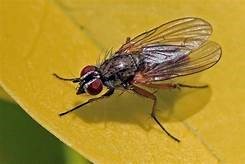
Fly control is made more difficult by animal production systems which often seem designed to favor fly production.This is accidental, of course, and the unplanned result of not considering fly production when designing livestock
and poultry production facilities.
Fly control measures must evolve to accommodate the developments in animal production and housing practices. The species of flies, their relative abundance and the success of fly control
measures are all affected by animal husbandry practices, especially housing and manure-handling systems. A multimethod management approach to fly control, using a mixture of cultural, biological and chemical control measures
adapted to the production system, will always provide the most cost-effective solution.To use this approach, it's important to have an understanding of the various fly species (including their biology and behavior),
parasites and predators of flies (biological control agents), manure management techniques, insecticides and insecticide application techniques.Reliance on the use of insecticides alone for fly control seldom provides a satisfactory
answer. Insecticides are most effective when the fly population is already suppressed with proper manure management methods which minimize fly breeding and encourage populations of fly predators and parasites.Resistance to
insecticides by flies, especially the house fly, is another important factor. Resistance to even new insecticides has been seen to develop rapidly as their use becomes widespread.Furthermore, resistance to one chemical is often
accompanied by cross-resistance to other, related chemical ,even if they have not been used for fly control. The search for new, effective fly control chemicals is a time-consuming and expensive process, with only occasional
success. It is therefore important to delay or avoid resistance development. This can only be achieved by using insecticides in conjunction with effective cultural and biological measures.All insect pests, including flies,
have fluctuating populations under natural conditions. Their numbers will rise and fall above and below a mean level.Effective management entails a combination of insect control methods to reduce that mean level to an acceptable
level; flies cannot be eliminated, but their numbers can be kept at a tolerable level. In the case of the house fly and other flies in confined-animal production facilities, the precise mean level that is acceptable depends
upon the circumstances. Regardless of this, an effective fly control management program should always be based on an integration of cultural, biological and chemical methods of fly suppression.
Fly Control